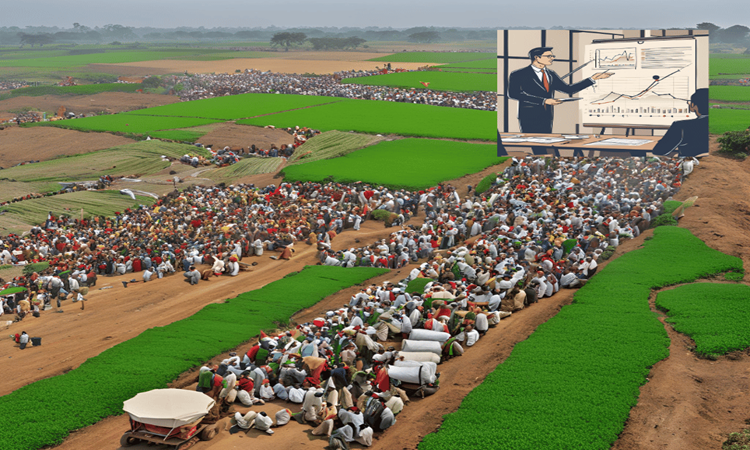
Farmers' Protest Continues Amidst Government's Efforts to Address Concerns
The farmers' protest, one of the largest and most enduring demonstrations in recent Indian history, shows no signs of abating as farmers continue to demand the repeal of controversial agricultural laws enacted by the government. The protest, which began in late 2020, has drawn widespread support from farmers across the country who fear that the new laws will undermine their livelihoods and leave them vulnerable to exploitation by corporate interests.
At the heart of the farmers' grievances are three agricultural laws passed by the Indian government in September 2020: the Farmers' Produce Trade and Commerce (Promotion and Facilitation) Act, the Farmers (Empowerment and Protection) Agreement on Price Assurance and Farm Services Act, and the Essential Commodities (Amendment) Act. Proponents of the laws argue that they will modernize India's agricultural sector, boost farmers' incomes, and attract much-needed investment. However, critics, including farmer unions and opposition parties, contend that the laws will dismantle the existing system of government-regulated markets, known as mandis, and leave farmers at the mercy of corporate buyers.
Despite multiple rounds of negotiations between the government and farmer representatives, a resolution to the impasse remains elusive. The farmers have rejected the government's offers to amend the laws, insisting on their complete repeal. The deadlock has led to a protracted standoff, with tens of thousands of farmers camping out on the outskirts of Delhi in makeshift protest camps, braving harsh weather conditions and the ongoing COVID-19 pandemic.
In response to the escalating crisis, the government has made several attempts to address the farmers' concerns while standing firm on its commitment to the agricultural reforms. In November 2020, Prime Minister Modi announced the repeal of the controversial farm laws, acknowledging the widespread discontent among farmers and the need for dialogue. However, the move failed to appease the protesting farmers, who remained steadfast in their demand for a legal guarantee of minimum support prices (MSP) for agricultural produce.
Subsequent rounds of negotiations between the government and farmer unions have yielded little progress, with both sides accusing each other of inflexibility and insincerity. The Supreme Court of India intervened in the dispute in January 2021, suspending the implementation of the farm laws and forming a committee to facilitate dialogue between the two parties. However, the committee's efforts were stymied by the farmers' refusal to engage with what they viewed as a biased and pro-government panel.
As the standoff enters its second year, the farmers' protest has evolved into a broader movement encompassing demands for agrarian reform, economic justice, and democratic rights. Solidarity rallies and demonstrations in support of the farmers have sprung up across India and around the world, amplifying their voices and drawing attention to their plight.
With the deadlock showing no signs of resolution, the farmers' protest has become a defining moment in Indian politics, highlighting the challenges of reconciling competing interests in a deeply divided society. As the government and farmers remain at an impasse, the fate of India's agricultural sector hangs in the balance, with far-reaching implications for the country's economy, social cohesion, and democratic future.
-- Thank You AN News --
 Anjali
1 Comments
Anjali 01 Jan 2045
Good and neat writing...
Leave a comment
Follow Us
Advertisement

Trending News


Newsletter
For Latest News Subscribe our Newletter